
If you run a property management company in Ireland, there is a good chance your operation looks something like this: tenant records in a spreadsheet, accounts in Sage or Xero, maintenance requests in a shared email inbox or WhatsApp group, rent collection through your bank portal, compliance deadlines in a wall calendar, and contractor bookings over the phone.
Each of those tools does its job in isolation. The problem is that none of them talk to each other. And that gap between systems is where your profits disappear.
This article breaks down exactly how fragmented software increases your cost per unit, creates compliance blind spots, and quietly erodes the margins that keep your business viable.
The Fragmented Software Problem
Most Irish PMCs grew organically. A company starts managing 20 or 30 units for a handful of landlords, picks up Sage for accounting, uses Excel for tenant records, and handles everything else through email and phone calls. It works well enough at that scale.
Then the portfolio grows to 100 units. Then 200. Then 500. And the cracks start to show.
The fundamental issue is data duplication. When a new tenant moves in, their details get entered into the tenancy spreadsheet, the accounting system, the bank portal for rent collection, and possibly a separate maintenance system. That is four instances of the same data, maintained independently, with no automatic synchronisation between them.
When a tenant’s rent changes, it has to be updated in multiple places. When someone moves out, the records need to be closed across every system. When a landlord asks for a financial summary, someone has to pull data from the accounting system, cross-reference it with the tenancy records, and manually compile a report.
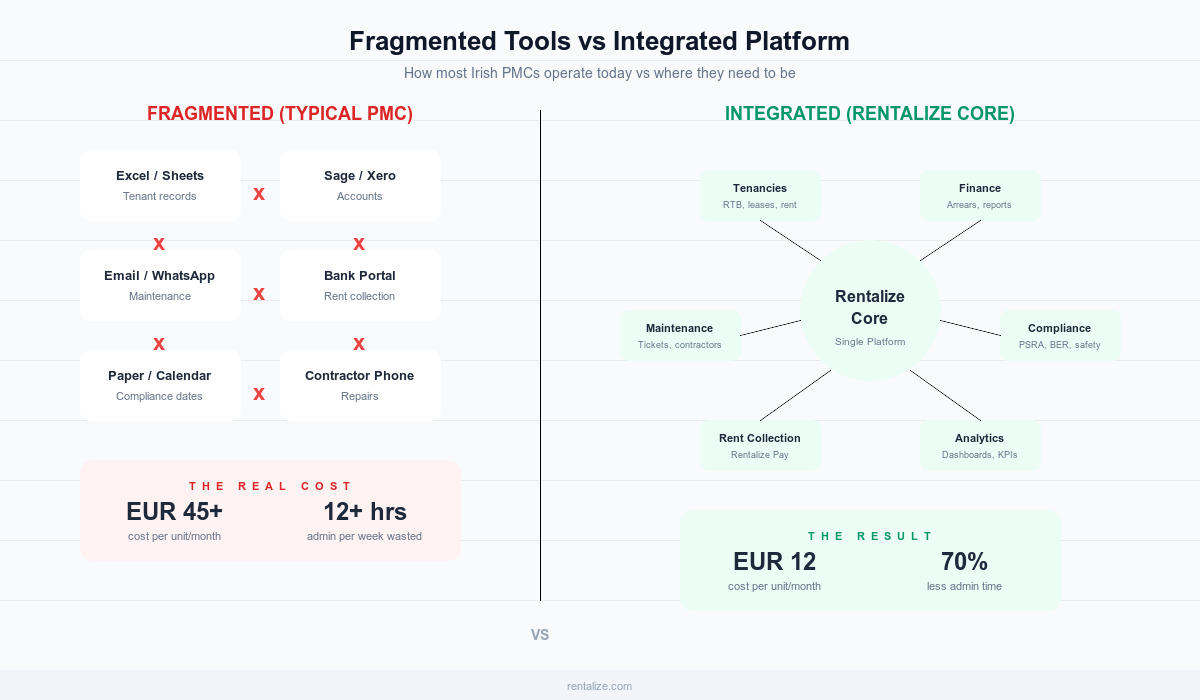
The diagram above shows the contrast between how most PMCs operate today (left) and what an integrated system looks like (right). On the left, six disconnected tools with no data flow between them. On the right, a single platform where every module shares the same data.
The Real Cost Per Unit
PMCs typically think about cost per unit in terms of software subscriptions. Sage costs X per month, the email service costs Y, the bank charges Z per transaction. Add those up and the number looks manageable, maybe EUR 3 to EUR 5 per unit per month.
But that is a fraction of the real cost. The biggest expense is staff time spent on tasks that only exist because the systems are not connected.
Manual Rent Reconciliation: EUR 12 per unit per month
This is consistently the biggest time sink. Every month, someone on your team logs into the bank portal, downloads a statement, opens the tenancy spreadsheet, and manually matches each payment to a tenant. For a 200-unit portfolio, this typically takes 12 to 15 hours per week. That is nearly two full working days, every week, spent on a task that an integrated system does automatically in real time.
Duplicate Data Entry: EUR 10 per unit per month
New tenant moves in? Enter their details in the spreadsheet, set them up in Sage, add them to the bank portal, create a contact in the maintenance system. Rent changes? Update it in three places. Tenant moves out? Close records in four systems. Across a year, this adds up to hundreds of hours of re-keying the same information.
Compliance Tracking: EUR 8 per unit per month
More on this below, but the short version is: tracking RTB registration deadlines, BER certificate expiry dates, gas safety service dates, fire safety checks, PSRA licence renewal, and rent review eligibility across hundreds of units using calendar reminders and spreadsheets requires dedicated staff time. Miss a deadline and the cost jumps from “admin time” to “tribunal fees and fines.”
Arrears Management: EUR 6 per unit per month
When rent does not arrive on time, someone needs to check the bank statement (which happens on a delay), identify the missing payment, cross-reference the tenant, and begin the follow-up process. In a fragmented setup, this is manual at every step. Phone calls, letters, checking whether the tenant has a history, logging the communication. An integrated system flags arrears automatically the moment a payment is missed and triggers a workflow.
Landlord Reporting: EUR 5 per unit per month
Landlords want to know how their property is performing. Monthly or quarterly reports covering rent collected, arrears, maintenance costs, void periods, and compliance status. In a fragmented setup, this means pulling data from multiple systems and compiling it manually. For PMCs managing properties for 50 or 100 different landlords, this is a significant recurring workload.
Maintenance Coordination: EUR 4 per unit per month
Tenant reports a broken boiler. The property manager receives an email or WhatsApp message, looks up the property in the spreadsheet, calls the contractor, waits for a callback, relays the details, follows up to confirm the job is done, then manually logs the cost in the accounting system. No ticket trail, no time tracking, no automatic cost allocation to the correct property.
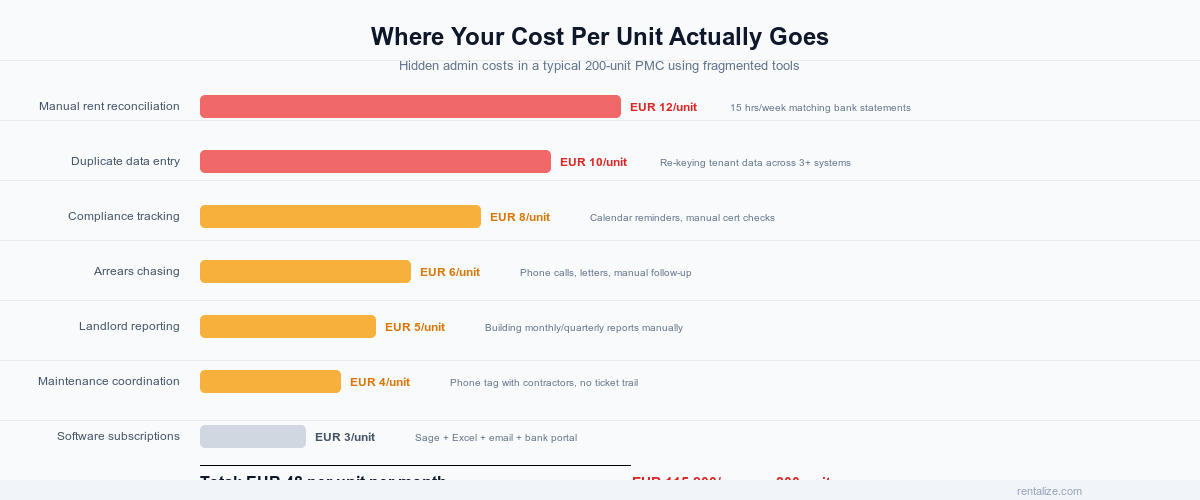
When you add it all up, the real cost per unit for a PMC running on fragmented tools is typically EUR 45 to EUR 50 per month, not the EUR 3 to EUR 5 they think they are spending. For a 200-unit portfolio, that is over EUR 115,000 per year in avoidable costs.
The Compliance Problem
Cost is one thing. Compliance is another. And in Ireland, the regulatory environment for rental properties has become significantly more demanding over the past five years.
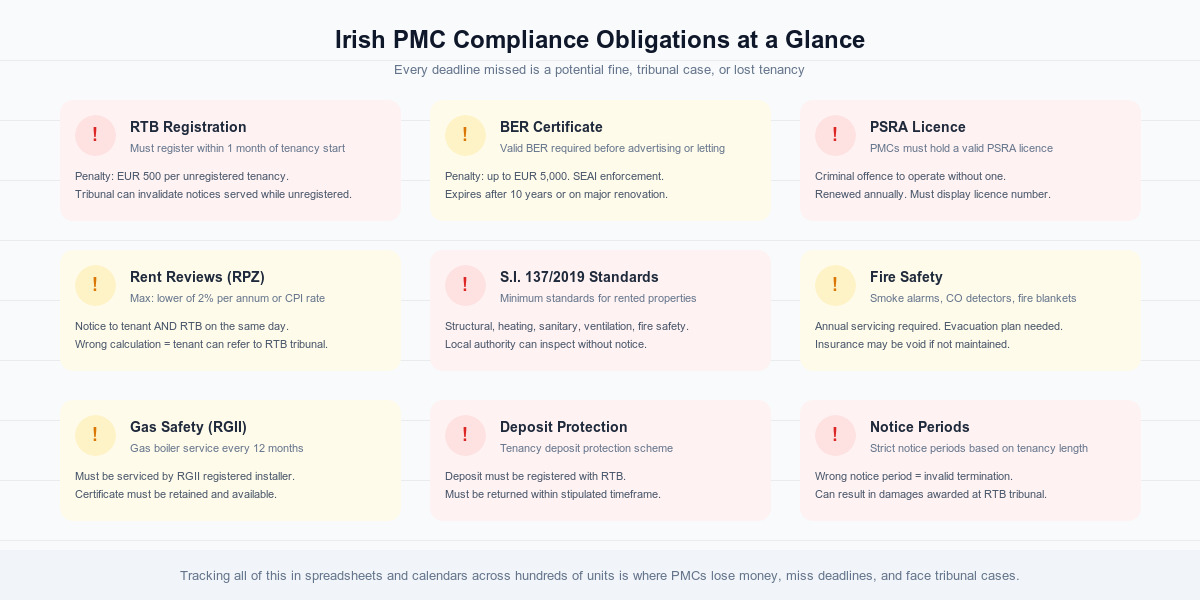
Irish PMCs must track and comply with at least nine distinct regulatory obligations per property. Each has its own deadlines, documentation requirements, and penalties for non-compliance.
RTB Registration
Every tenancy must be registered with the Residential Tenancies Board within one month of commencement. The penalty for late or non-registration is EUR 500 per tenancy. More critically, notices served while a tenancy is unregistered can be invalidated by the RTB tribunal. This means a PMC that fails to register a tenancy on time could find that their Notice of Termination, served months later, is thrown out because the tenancy was not registered at the time.
For a PMC managing 200 units with regular turnover, tracking registration deadlines in a spreadsheet is a formula for missed deadlines.
Rent Reviews in Rent Pressure Zones
Under the Residential Tenancies (Amendment) Act 2024, rent increases in Rent Pressure Zones are capped at the lower of 2% per annum or the current CPI rate. The notice must be sent to both the tenant and the RTB on the same day. The calculation must account for the exact number of days since the last review, apply the correct CPI figure, and compare it against the 2% threshold.
Getting this wrong is not a minor issue. If the calculation is incorrect, the tenant can refer the matter to the RTB tribunal. If the notice was not sent to the RTB on the same day it was sent to the tenant, the rent increase is invalid. A PMC doing these calculations manually across dozens of properties each quarter is taking on significant risk.
BER Certificates
A valid Building Energy Rating certificate is required before a property can be advertised or let. Certificates expire after 10 years or when a major renovation is completed. The penalty for letting without a valid BER is up to EUR 5,000, enforced by SEAI.
Tracking expiry dates across a large portfolio means knowing, for each property, when the BER was issued, whether any renovations have been done since, and when it needs to be renewed. This is exactly the kind of date-based compliance task that falls through the cracks when managed in spreadsheets.
S.I. 137/2019 Minimum Standards
The Housing (Standards for Rented Houses) Regulations 2019 set out detailed minimum standards for structural condition, heating, sanitary facilities, ventilation, fire safety, refuse storage, and food preparation areas. Local authorities can inspect properties without prior notice.
For PMCs, this means maintaining an up-to-date record of the condition of every property, scheduling and tracking regular inspections, and documenting remediation work. Without a system that links property condition data to maintenance records and inspection schedules, gaps inevitably appear.
PSRA Licence
It is a criminal offence to operate as a property management agent in Ireland without a valid Property Services Regulatory Authority licence. Licences must be renewed annually. The PSRA number must be displayed on all marketing materials. While this is a company-level obligation rather than per-property, losing track of the renewal date has obvious consequences.
Fire Safety, Gas Safety, and Deposit Protection
Each property needs annual gas boiler servicing by an RGII-registered installer, working smoke alarms and carbon monoxide detectors, a fire blanket in the kitchen, and an evacuation plan in multi-unit buildings. Deposits must be registered with the RTB under the Tenancy Deposit Protection scheme.
None of these are difficult to comply with individually. The challenge is tracking them across hundreds of properties, each with different service dates, different contractors, and different renewal cycles.
The Asset Management Gap
Beyond tenancy compliance and day-to-day operations, there is a broader asset management problem that fragmented software cannot address.
Property owners, whether they are individual landlords, institutional investors, or housing bodies, need visibility into the performance and condition of their assets over time. That means tracking:
- Yield per property: Rent collected minus costs (maintenance, management fees, insurance, void periods) divided by property value. Without integrated financial data, this calculation requires manual compilation from multiple sources.
- Maintenance spend trends: Is a particular property’s maintenance cost increasing year on year? Is the boiler approaching end of life? Is there a pattern of plumbing issues that suggests a deeper problem? Answering these questions requires historical maintenance data linked to property records.
- Void periods: How long does each property sit empty between tenancies? What is the re-letting time? How does this compare across the portfolio? Without integrated tenancy records, this data has to be manually extracted and analysed.
- Capital expenditure planning: Knowing which properties need major works in the next 12 to 24 months requires a view that combines property age, condition assessments, maintenance history, and compliance certificate dates. No spreadsheet provides this view.
For institutional landlords and investment fund managers, this data is not optional. They need it for board reporting, investor updates, and regulatory filings. When their PMC cannot provide it because the data lives across five different systems, the relationship is at risk.
What Integration Actually Looks Like
An integrated property management platform eliminates the gaps between systems by putting everything in one place. Here is what changes:
Tenant moves in: Enter the details once. The system creates the tenancy record, sets up the rent schedule, triggers an RTB registration reminder, schedules the first compliance check, and makes the tenant available for maintenance requests. One entry, five outcomes.
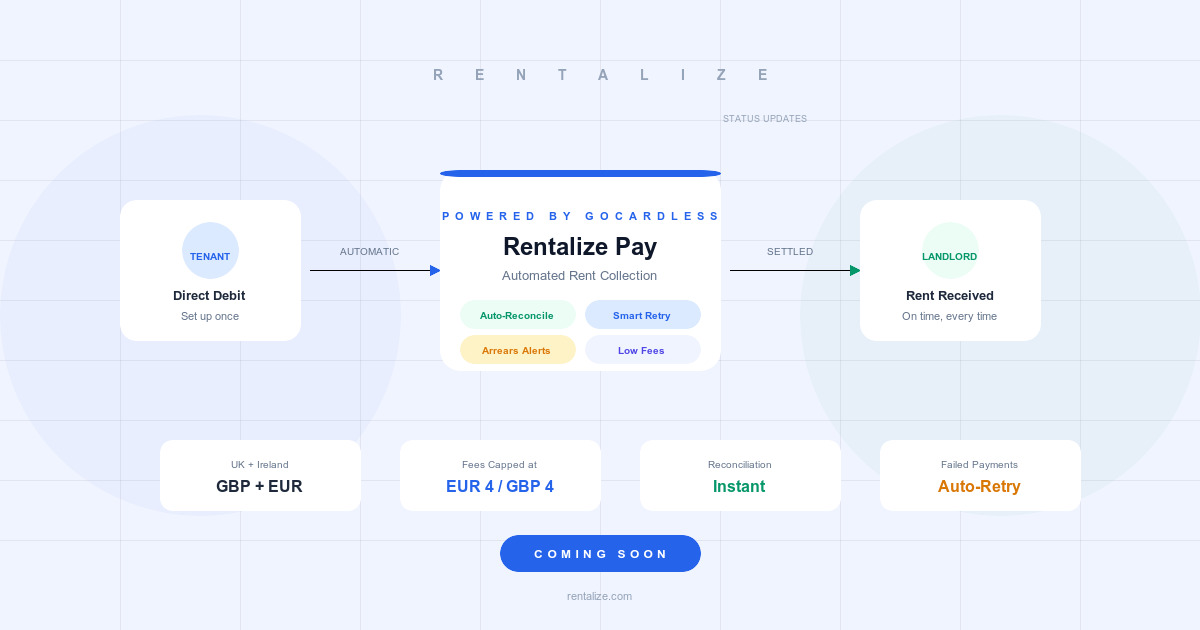
Rent is due: The system collects rent automatically via direct debit, matches it to the tenant record, updates the financial ledger, and flags any missing payments immediately. No bank statement downloads, no manual matching.
Maintenance request: The tenant submits a request through a portal. The system creates a ticket, assigns it to the appropriate contractor based on the issue type and property location, tracks the response time, logs the cost against the property, and includes it in the next landlord report. No phone tag, no lost emails.
Compliance deadline approaching: The system alerts you 30 days before a BER expires, a gas safety certificate is due, or an RTB registration window is closing. The alert includes the property address, the specific requirement, and the action needed. No calendar reminders to set up manually.
Landlord requests a report: Click a button. The system generates a summary covering rent collected, arrears, maintenance costs, compliance status, and void periods for that landlord’s properties. No data pulling from three different systems.
The Numbers: Fragmented vs Integrated
For a PMC managing 200 units:
| Metric | Fragmented Tools | Integrated Platform |
|---|---|---|
| Cost per unit per month | EUR 45 to 50 | EUR 10 to 15 |
| Admin hours per week | 40+ hours | 12 to 15 hours |
| Rent reconciliation time | 12 to 15 hrs/week | 0 (automatic) |
| Compliance incidents per year | 8 to 15 missed deadlines | 0 (automated alerts) |
| Landlord report generation | 2 to 4 hours each | Under 1 minute |
| Data entry per new tenancy | 4 systems, 45 mins | 1 system, 10 mins |
| Annual avoidable cost (200 units) | EUR 115,200 | EUR 0 |
The difference is not marginal. It is the difference between a PMC that is profitable at scale and one that is slowly drowning in admin while its margins shrink.
Why This Matters Now
Three trends are making this problem urgent for Irish PMCs in 2026:
1. Regulatory pressure is increasing. The Residential Tenancies (Amendment) Act 2024 introduced new notification requirements for rent reviews. The RTB’s enforcement powers have expanded. SEAI is stepping up BER enforcement. Local authorities are increasing property inspections. The compliance burden per unit is going up, not down.
2. Landlord expectations are rising. Institutional investors and housing bodies now expect real-time portfolio dashboards, automated financial reporting, and documented compliance audit trails. PMCs that cannot provide this level of visibility are losing mandates to competitors who can.
3. Margins are under pressure. Management fees have not kept pace with the increased regulatory workload. The only way to maintain profitability is to reduce the cost per unit through operational efficiency. That means automation, not more staff.
What to Do About It
If you recognise the fragmented software problem in your own PMC, the path forward is straightforward:
- Audit your current cost per unit. Not just software subscriptions, but staff time spent on reconciliation, data entry, compliance tracking, reporting, and maintenance coordination. The number will be higher than you expect.
- Map your compliance obligations. List every regulatory deadline per property: RTB registration, BER expiry, gas safety, fire safety, rent review eligibility. Identify how many are currently tracked manually.
- Evaluate integrated platforms. Look for a system that covers tenancy management, financial reporting, maintenance ticketing, compliance tracking, and rent collection in a single platform. Rentalize Core was built specifically for this, designed for Irish PMCs managing 50 to 2,000+ units with built-in Irish compliance (RTB, PSRA, RPZ rent reviews, S.I. 137/2019).
- Calculate the ROI. Compare your current cost per unit against the cost of an integrated platform. For most PMCs, the platform pays for itself within the first quarter through reduced admin time alone.
The property management industry in Ireland is professionalising rapidly. The PMCs that will thrive are the ones that treat operational efficiency as a competitive advantage, not an afterthought. Fragmented tools were fine when you managed 30 units. At 200 or 500, they are actively costing you money.
If you want to see what an integrated approach looks like for your portfolio, book a demo with our team.
Related Posts