
 Property Management
Awaab’s Law phase 2: cold, heat, falls, fire and electrical hazards
Key takeaways Awaab's Law phase 1 came into force for social landlords on 27 October 2025, covering damp, mould and all emergency hazards. Phase...
Key takeaways
A Dublin landlord we spoke to in June had done the arithmetic properly. He had checked the cap, applied it to the right base, given his tenant a full 90 days, and put the letter in the post. Four months later he found out the rent had never legally changed, because nobody had told him the RTB needed a copy on the same day, which was the rule at the time.
He is not unusual. The rent rules that came in on 1 March 2026 changed the sum most landlords worried about, so that is what everyone read about. The change that quietly voids more notices is procedural, it is buried in the service requirements, and it has very little forgiveness built into it.
This is what the new notice regime actually demands, in the order you will meet it: when the clock starts, what has to be in the envelope, and the single step that makes everything else irrelevant if you miss it.
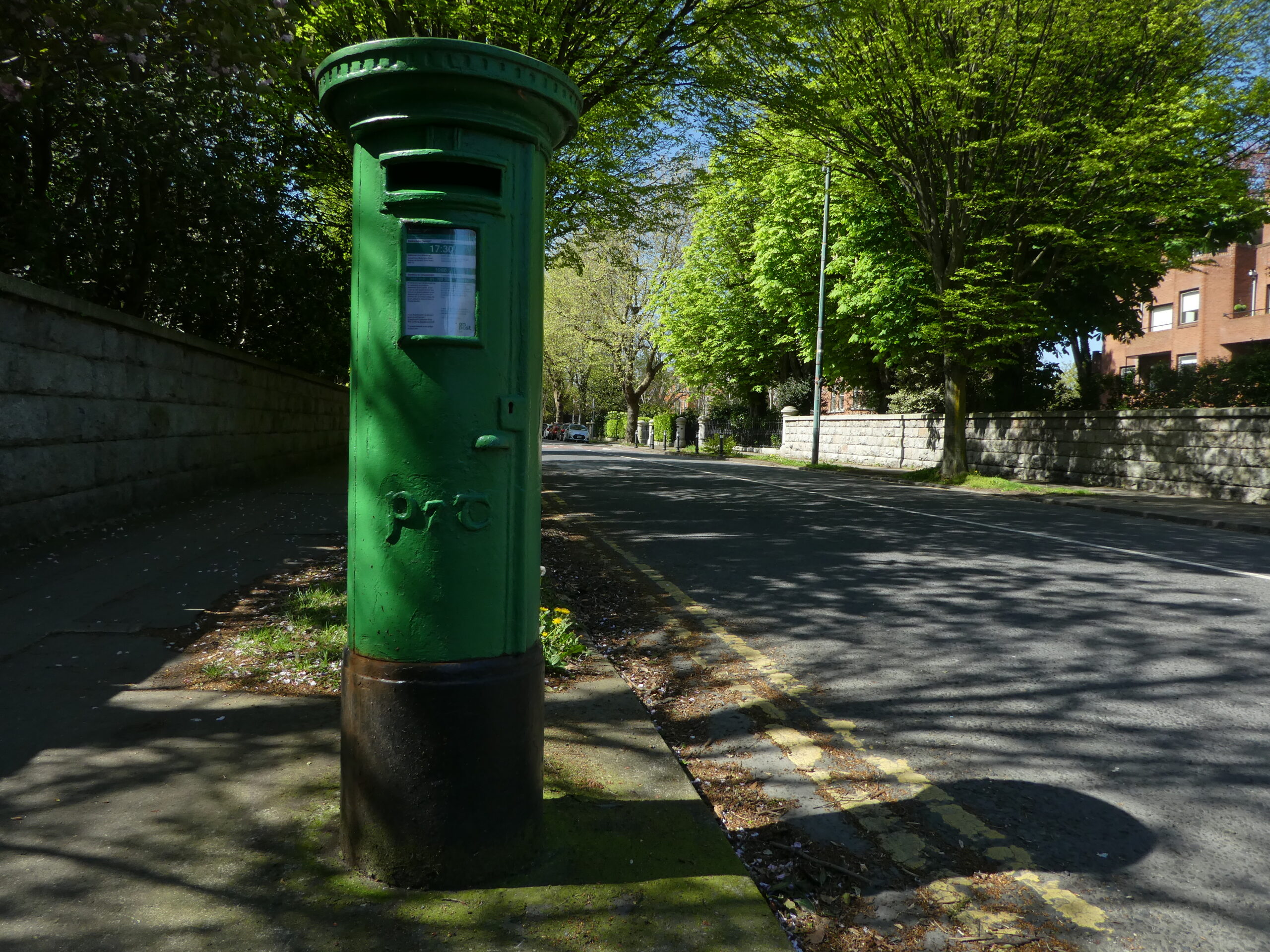
Header photo: An Post pillar box, Shrewsbury Road, Dublin, by Leimanbhradain, CC0, via Wikimedia Commons.
On this page
Rent Pressure Zones were abolished and replaced with a single national rent control. Rent can rise once every 12 months by 2 per cent or the rate of CPI inflation, whichever is lower. With CPI running above 2 per cent through most of this year, the 2 per cent limb is the one that binds for a standard tenancy.
Two groups sit outside that. Apartments and student specific accommodation in developments that commenced on or after 10 June 2025 follow CPI with no 2 per cent ceiling. Approved housing body and cost rental tenancies are outside national rent control altogether, and are covered in our cost rental guide.
That is the part that got the coverage. The part that did not is that the same Act rewrote how a rent change is communicated, and made the RTB a required recipient rather than an interested party.
A rent review notice must be served on the tenant, and a copy served on the RTB within 7 days of the date the tenant was served. That is section 22(2) of the Residential Tenancies Act 2004, as amended with effect from 14 September 2026. Between 1 March and 13 September 2026 the rule was stricter: the copy had to go the same day.
If the copy is not served in time, the condition the Act sets for the new rent is not met and the rent does not change. The RTB can write asking for the copy, and ignoring its follow-up notice is an offence, but that does not make a late copy safe to rely on. The safe course is a fresh notice, and the 90 day period the tenant is entitled to starts again from the new service date, which pushes the increase out by another quarter.
A rent setting notice at the start of a new tenancy works differently. It goes to the RTB within one month of the tenancy start date.
This is the failure that costs the most, because it is invisible. Nothing bounces. The tenant receives a letter that looks entirely correct, may well start paying the new amount, and the problem only surfaces when somebody with a reason to check goes looking. By then there can be months of overpayment to unwind.
Alongside the notice itself you have to send a statement, and what goes in it depends on your route.
If the rent is capped, the statement must include a printout from the RTB Rent Calculator showing how you arrived at the new figure, plus details of 3 comparable properties from the RTB Rent Register. Your own spreadsheet does not satisfy this, however carefully you built it. The Act names the RTB tool specifically, which is why our checker deliberately does not produce a rival number and points you at theirs instead.
If you are setting rent at market rate, the statement must show that the rent is not above market. You prove that with details of 3 comparable tenancies from the RTB Rent Register, and the bar is tighter than most landlords expect. Each must be similar in size, type and character including BER, and each tenancy must have begun in the last 3 months.
That 3 month window is the detail that catches people. Comparables cannot be gathered once and reused across a portfolio, because they expire. If you manage 40 tenancies with reviews spread through the year, you are pulling fresh evidence each time.
Whether you can set market rent at all depends on facts about the tenancy that have nothing to do with the rent. A market reset is allowed where the previous tenant left by choice, breached their obligations, or the home no longer met their needs. It is allowed for a first tenancy, after 2 years with no tenancy, or at the end of a 6 year Tenancy of Minimum Duration.
It is blocked after a no fault termination. If the last tenancy ended because you or a family member needed the property, or because you were changing its use, the new rent stays capped. That distinction is the point of the reform and the RTB checks it.
A sitting tenancy that began before 1 March 2026 cannot be reset to market rent at all while it continues. If you are unsure which of these describes your situation, the notice checker walks the decision in six questions, and our rent increase calculator handles the euro amount once you know the route.
The direct cost is the rent you did not lawfully collect. If a tenant has been paying an increase under an invalid notice, that money is arguably not owed, and the longer it runs the larger the unwind.
The indirect cost is worse for anyone managing at scale. An invalid notice is a defective paper trail, and defective paper trails surface at the least convenient moment, which is usually a dispute. A letting agent who cannot evidence valid service across a portfolio is carrying a liability on behalf of clients who assume it is handled.
There is a reputational edge too. Tenants increasingly know these rules. A notice that fails on service is an argument you have handed to the other side for free.
The fix is not more care. Careful people miss this, because the failure gives no feedback. The fix is to make the RTB copy structurally impossible to skip.
In practice that means three things. Generate the notice and the RTB submission as one action rather than two, so there is no step that can be forgotten. Store the RTB confirmation with the served copy and the calculator printout as a single bundle, because that bundle is your defence. And diary the next permitted review date at the moment you serve, since the interval is 12 months, or 24 in an area that only became a Rent Pressure Zone within the previous 2 years.
If you are running this on a spreadsheet across more than a handful of tenancies, the question is not whether a notice will be missed but which one.
Rentalize generates the tenant notice and the copy for the RTB together, from the same calculation, so the copy is ready the moment the notice is. The notice, the RTB copy and the supporting statement are kept together against the tenancy, which is the form the evidence needs to be in if a rent is ever challenged. Serving the tenant and sending the copy to the RTB within 7 days are still your steps.
The rent review workflow sits inside Rentalize Core, used by property management companies and letting agents managing reviews across many landlords at once, and by housing bodies. Our rent review software page covers the workflow in detail.
If you would like to see how the notice and the RTB copy are generated together, you can book a 20 minute walkthrough, or look at pricing first.
Most commonly, not sending it to the RTB. The notice must be served on the tenant and a copy served on the RTB within 7 days, and if the copy is not served in time the new rent does not take effect regardless of whether the figure is correct. Missing the 90 day notice period, or attaching the wrong supporting statement for your pathway, will also defeat it.
Do not rely on it. The copy is due within 7 days of serving the tenant, and a copy sent after that does not meet the condition as the Act words it. The safe course is a fresh notice, and the tenant’s 90 day period runs again from the date of the new service, so the increase is delayed by roughly a quarter.
Once every 12 months, by 2 per cent or the rate of CPI inflation, whichever is lower. Because CPI has been above 2 per cent for most of 2026, the 2 per cent limb is the binding one for a standard tenancy. Apartments and student accommodation in developments commenced on or after 10 June 2025 can follow the full CPI figure with no cap.
The RTB Rent Register. Each must be a property of similar size, type and character including BER, and each tenancy must have begun within the last 3 months. You identify them by Registered Tenancy number.
No. National rent control does not apply to approved housing body or cost rental tenancies, which set rent from the cost of providing the home rather than from the market.
Property Management
Key takeaways Awaab's Law phase 1 came into force for social landlords on 27 October 2025, covering damp, mould and all emergency hazards. Phase...
 Software Selection
Key takeaways MTD replaces one annual return with four quarterly updates and a Final Declaration. The quarterly updates are summaries, not mini tax returns....
 Software Selection
Key takeaways Making Tax Digital for Income Tax has applied since April 2026 to qualifying income above 50,000 pounds. From April 2027 the threshold...
Free calculators and in-depth guides to Irish housing schemes.
Go or no-go viability for AHBs, the LDA and councils, across STAR, CREL and the AHF.
Learn more →Check eligibility and estimate Cost Rental rent across Ireland.
Learn more →Work out your HAP limit and any tenant top-up.
Learn more →