A housing management system is not the same as landlord software. It has to run rents and arrears, repairs, asset and compliance data, and regulator reporting for a whole stock, which is why a purpose-built housing management system matters more than a general property tool.
The enterprise incumbents (Aareon, MRI, Civica, NEC) are deep and proven at very large scale, but carry long implementations and quote-only pricing that can run into years and six figures.
For small and mid-size providers, the practical choice in 2026 is between a lighter incumbent (PyramidG2, Landlord Vision) and a modern platform that deploys in weeks.
Awaab’s Law, the Decent Homes Standard, and the Renters’ Rights Act have moved damp, repairs timescales, and compliance reporting to the centre of what a system must handle.
Match the system to your stock size and your appetite for implementation time. The right answer for a 400-home association is rarely the right answer for a 40,000-home one.
If you are shopping for the best housing management system in the UK for 2026, the first thing to know is that the market splits into two very different halves, and most buyer’s guides blur them together. On one side sit the enterprise platforms that run the largest housing associations and councils, built over decades and priced accordingly. On the other sit lighter systems and a new group of modern platforms that a smaller registered provider can stand up in weeks. Picking the wrong half wastes either money or capability.
This guide compares the systems that UK social landlords, housing associations, and local authorities actually shortlist. It looks at what each one is genuinely good at, where it is weaker, who it suits, and what to expect on price and implementation. Where a competitor does something better than Rentalize Core, we say so, because a shortlist built on marketing claims helps no one.
By the end you will have a clear view of which system fits your organisation’s size, your regulatory obligations, and your timeline for getting live.
Short answer: For very large stock (10,000-plus homes) with complex asset and repairs operations, Aareon, MRI, and Civica remain the established choices. For small and mid-size registered providers and local authorities that want a modern, AI-assisted system live in weeks rather than years, Rentalize Core is the strongest 2026 alternative, with rents, repairs, compliance, and tenant portals in one platform and transparent pricing. The best fit depends on your stock size, which the comparison below sets out.
What a housing management system actually does in 2026
A housing management system, or HMS, is the operational core of a social landlord. It is not a spreadsheet replacement and it is not the same category as private landlord software. It holds the tenancy record for every home, calculates and posts rent and service charges, tracks arrears and recovery, logs and schedules repairs, stores stock condition and asset data, and produces the reports the regulator and your board expect.
For a housing association or council, that last point is where 2026 raises the bar. The Regulator of Social Housing’s consumer standards, the Decent Homes Standard, and the arrival of Awaab’s Law mean a system now has to evidence how fast damp and mould reports are actioned, not just record that they exist. A modern HMS treats compliance as live data, not an annual paper exercise.
Housing management is not landlord software
Tools like Landlord Vision, Hammock, or Arthur are built for private landlords and letting agents managing a portfolio. They handle rent tracking, bank feeds, and tax reporting well. A registered provider needs more: service-charge accounting, void and allocation workflows, repairs contractor scheduling, stock condition surveys, and statutory returns. Confusing the two categories is the most common and most expensive shortlisting mistake.
The features your shortlist must include
Before comparing vendors, fix the requirements. Every system below covers the basics, so the shortlist should be decided on how well each handles the areas that carry regulatory or financial risk.
Rents, service charges, and arrears
The system must calculate rent and variable service charges, post them on schedule, and give housing officers a real-time arrears position with recovery workflows. Direct debit and open banking rent collection reduce the manual reconciliation that eats officer time. Weak arrears tooling is where small providers quietly lose money.
Repairs and Awaab’s Law timescales
Repairs is now a compliance function, not just a maintenance one. Awaab’s Law sets fixed timescales for investigating and fixing damp and mould, so the system has to timestamp a report, track it against the statutory clock, and escalate before a deadline is missed. Contractor scheduling, appointment booking, and a resident-facing status view are the difference between meeting the standard and evidencing that you did.
Assets, stock condition, and Decent Homes
A credible HMS holds component-level asset data so you can plan investment and prove homes meet the Decent Homes Standard. For large stock this is a major module in its own right, and it is where the enterprise systems are genuinely strong.
Compliance and regulator reporting
Gas, electrical, fire, asbestos, legionella, and lift safety all carry certificate deadlines. The system should track every certificate, flag expiries early, and roll up into the returns the Regulator of Social Housing and your board require. If you also operate in Ireland, the same discipline applies to differential rent and cost rental administration.
Tenant portal and self-service
A tenant portal that lets residents report repairs, check rent balances, and message their officer cuts inbound calls and improves satisfaction scores that feed the regulator’s tenant measures. Mobile access for field staff is now expected, not a premium extra.
The best housing management systems in the UK for 2026
The systems below are the ones UK social landlords most often shortlist, ordered roughly from the largest enterprise incumbents to the modern and lighter options. There is no single winner. The right choice depends on your stock size and how quickly you need to be live.
1. Aareon QL (and Aareon Quantum)
Aareon is one of the most widely deployed housing systems in the UK, with QL and its cloud successor Quantum used across many of the largest associations. Its strength is breadth and scale: rents, repairs, assets, CRM, and mobile working for very large, complex portfolios, backed by a long track record. The trade-offs are the ones common to enterprise software. Implementations are measured in many months to years, configuration is involved, and pricing is quote-only and significant. It is a strong fit for large providers that need depth and have the project capacity to match.
2. MRI Social Housing
MRI’s social housing suite, which absorbed products such as Orchard and Castleton, targets established associations and local authorities managing large stock with complex finance, asset, and reporting needs. It is capable and widely used, with a deep partner ecosystem. As with any enterprise platform, the depth comes with implementation time, integration work, and enterprise pricing. Best suited to organisations that want a heavyweight, modular system and have the internal resource to run it.
3. Civica Cx
Civica Cx is a cloud housing management platform used by many UK housing associations and councils, covering tenancy, rents, repairs, assets, and customer portals with modular flexibility. Civica’s scale across the wider public sector is a genuine advantage for integration with local-government systems. The considerations are familiar for the enterprise tier: a substantial implementation and a commercial model built for larger organisations rather than smaller providers.
4. NEC Housing (formerly Northgate)
NEC Housing, previously Northgate Public Services, is long established in local-authority housing and among housing associations. Its heritage is strong on council housing management and integration with wider local-government software. It is a mature, proven system, and, like its enterprise peers, it rewards organisations with the scale and project capacity to implement and configure it fully.
5. PyramidG2 by OmniLedger
PyramidG2 is aimed squarely at small and mid-size social landlords, and OmniLedger reports it is trusted by well over a hundred social landlords nationwide. For a smaller association it is a more proportionate and affordable option than the enterprise systems, covering the core housing management functions without the weight. Its ceiling is scale and the breadth of the very largest suites, which is exactly the trade a smaller provider is usually happy to make.
6. Landlord Vision
Landlord Vision is a UK portfolio and property management platform built primarily for private landlords and smaller organisations moving off spreadsheets. It handles rents, accounting, and reporting cleanly and is inexpensive relative to a full HMS. It is not a like-for-like housing management system for a registered provider with service charges, allocations, and statutory returns, but for a very small social landlord or a subsidiary managing market-rent stock it can be a sensible, low-cost starting point.
7. Rentalize Core
Rentalize Core is a modern, AI-assisted housing management platform for registered providers, local authorities, and property management companies managing roughly 50 to 5,000 homes. It brings rents and arrears, repairs with Awaab’s Law timescales, asset and compliance tracking, and tenant and staff portals into one system, with open banking rent collection through Rentalize Pay built in. Its two genuine differentiators are speed and affordable-housing depth: a typical go-live is measured in weeks rather than years, and cost rental, differential rent, and allocation workflows are native rather than bolted on, which matters for providers operating across the UK and Ireland. Where it does not yet compete is the very top of the market. For a 40,000-home association with a large in-house repairs operation, the established enterprise suites still hold an edge on sheer breadth and installed-base maturity. For everyone below that, Core is built to be the faster, more modern option.
How the main housing management systems compare
The table summarises the practical differences. Read it as a shortlisting aid, not a scorecard, because the right system depends on your stock size and timeline.
System
Best for
Implementation
Pricing model
Modern / AI
Aareon QL / Quantum
Very large associations
Months to years
Quote only, enterprise
Modernising
MRI Social Housing
Large associations, councils
Months to years
Quote only, enterprise
Modular
Civica Cx
Associations and councils
Months
Quote only, enterprise
Cloud
NEC Housing
Council housing
Months
Quote only, enterprise
Mature
PyramidG2
Small to mid social landlords
Weeks to months
Mid-market
Established
Landlord Vision
Very small / market-rent
Days
Low, subscription
SME tool
Rentalize Core
Small to mid providers, 50 to 5,000 homes
Weeks
Transparent, modular
AI-native
Source: Rentalize analysis of the UK housing management software market, 2026. Free to share with attribution.
Who each system suits
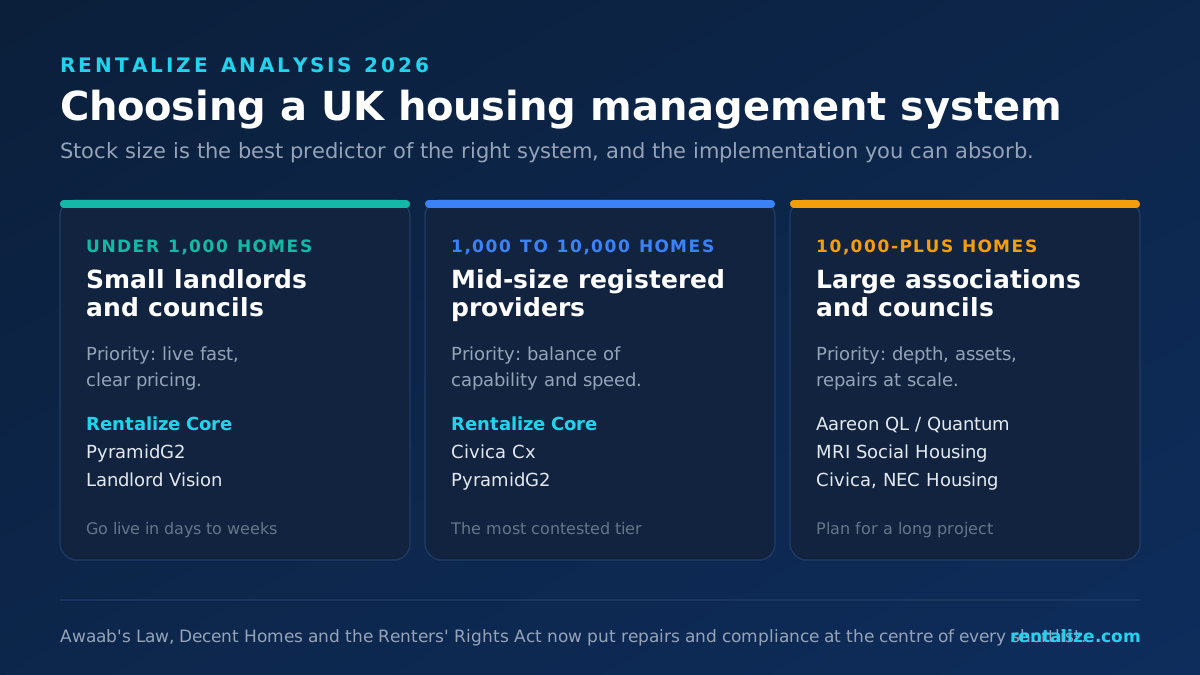
Stock size is the single best predictor of the right choice, because it drives both the capability you need and the implementation you can absorb.
Very large associations (10,000-plus homes)
If you run a large, complex portfolio with an in-house repairs operation and heavy asset-management needs, the enterprise suites earn their keep. Aareon, MRI, and Civica have the depth, the installed base, and the integration ecosystems that scale demands. Budget for a long implementation and a formal project team.
Mid-size registered providers (1,000 to 10,000 homes)
This is the most contested tier. An enterprise system may be more than you need, while an SME tool is not enough. A modern platform like Rentalize Core, or a proportionate incumbent, often gives the best balance of capability, speed, and cost. This is also where the approved housing body and registered-provider workflows matter most.
Small social landlords and councils (under 1,000 homes)
Here, implementation time and price dominate. A system that goes live in weeks and prices transparently protects a small team from a project that swallows a year. PyramidG2 and Rentalize Core both target this group, from different starting points.
What a housing management system costs, and what to expect
Enterprise HMS pricing is almost always quote-only, and total cost runs well beyond the licence. Data migration, configuration, integration, training, and the internal time to run the project can equal or exceed the software fee, and implementations of a year or more are normal at the top of the market.
Modern platforms have pushed against this. Rentalize publishes transparent pricing and a typical go-live measured in weeks, which changes the business case for smaller providers who cannot carry a multi-year project. Whichever route you take, the honest budgeting question is not the annual licence, it is the fully loaded cost of getting live and staying compliant. You can model your own figures with the pricing calculator.
Where Rentalize Core fits
Rentalize Core was built for the tier the enterprise systems underserve: small and mid-size registered providers, councils, and property management companies that want a genuinely modern system without a genuinely enormous project. Rents, arrears, repairs with Awaab’s Law timescales, asset and compliance tracking, tenant and staff portals, and open banking rent collection sit in one platform, with an AI assistant that drafts communications and surfaces the arrears and compliance cases that need attention first.
The two things it does that the incumbents largely do not are speed and affordable-housing depth. A typical implementation is measured in weeks, and cost rental, differential rent, and allocation workflows are native, which matters for providers operating across the UK and Ireland. If you are weighing it against a named competitor, the side-by-side comparisons set out where each one is stronger, including an honest look at Rentalize versus Tilt Affinity.
If you would like to see how Core would handle your stock, you can review transparent pricing or book a 20-minute walkthrough with the team.
Frequently asked questions
What is the best housing management system in the UK for 2026?
There is no single best system for every provider. For very large associations with complex asset and repairs operations, Aareon, MRI, and Civica remain the established enterprise choices. For small and mid-size registered providers and councils that want a modern system live in weeks rather than years, Rentalize Core is the strongest 2026 alternative. The right answer depends on your stock size and implementation timeline.
What is the difference between housing management software and landlord software?
Landlord software, such as Landlord Vision or Hammock, is built for private landlords and letting agents and handles rent tracking, bank feeds, and tax reporting. A housing management system adds what a registered provider needs: service-charge accounting, void and allocation workflows, repairs contractor scheduling, stock condition and asset data, and statutory returns to the Regulator of Social Housing.
How does Awaab’s Law affect housing management software?
Awaab’s Law introduces fixed timescales for investigating and fixing damp and mould. A capable system timestamps each report, tracks it against the statutory deadline, escalates before it is missed, and evidences the response for the regulator. Repairs has effectively become a compliance function, so the quality of repairs and case-tracking tooling now matters more than it used to.
How much does a housing management system cost?
Enterprise systems are quote-only, and total cost includes migration, configuration, integration, and training on top of the licence, with implementations of a year or more common. Modern platforms such as Rentalize publish transparent pricing and go live in weeks, which lowers the fully loaded cost for smaller providers. Budget for the cost of getting live, not just the annual licence.
Can a modern platform replace an enterprise housing system?
For small and mid-size providers, yes. A modern platform like Rentalize Core covers the core housing management, repairs, compliance, and portal functions those organisations need, and deploys far faster. For the very largest associations with deep asset-management and in-house repairs operations, the established enterprise suites still hold an advantage on breadth and installed-base maturity.
Does a UK housing management system need to handle Irish schemes too?
Only if you operate across both markets. Providers that manage stock in Ireland need native support for cost rental, differential rent, and HAP, which most UK-only systems do not offer. Rentalize handles both, which is useful for cross-border providers. You can explore the Irish side through the differential rent calculator and the cost rental software pages.
The rules moved a long way in 2026 and they are still moving. These are the obligations landlords and letting agents are working to right now, each with the dates and the penalties attached.
Key takeaways MTD replaces one annual return with four quarterly updates and a Final Declaration. The quarterly updates are summaries, not mini tax returns....
Key takeaways Making Tax Digital for Income Tax has applied since April 2026 to qualifying income above 50,000 pounds. From April 2027 the threshold...


 Software Selection