Cost rental viability for AHBs: CREL, STAR and the numbers
allen
June 23, 2026
7 min read
Key takeaways
An AHB cost rental scheme is viable only when the cost-covering rent lands at least 25% below market and stays affordable. You can test any scheme in two minutes with the cost rental feasibility calculator.
CREL covers up to 30% of cost as a 40 year equity loan, with the rest funded by a Housing Finance Agency loan. A State equity element of up to 20% can be added to reach viability.
STAR adds State equity up to EUR 175,000 per unit in Dublin and EUR 150,000 elsewhere, plus EUR 25,000 for sustainable development.
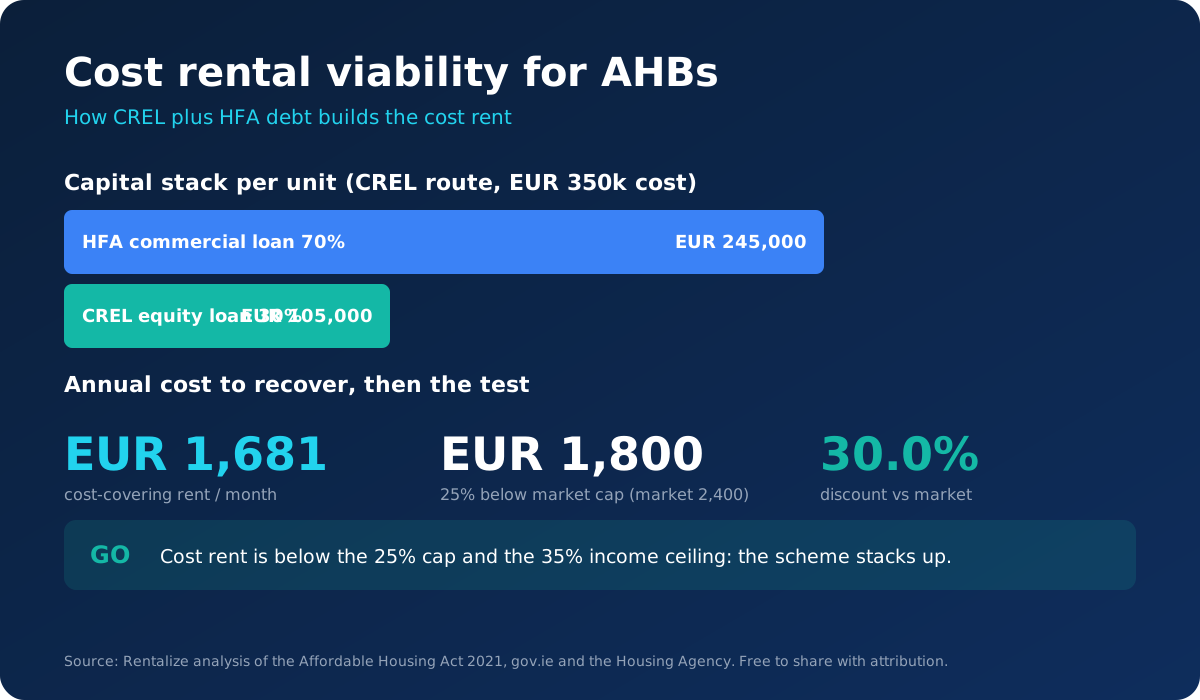
On a EUR 350,000 per unit Dublin scheme the cost rent works out near EUR 1,681 per month, about 30% below a EUR 2,400 market rent, a clear go.
Push the cost to EUR 450,000 and the same scheme needs roughly EUR 97,000 of extra equity per unit to get back below the 25% line.
Clúid, Respond and Tuath delivered Ireland’s first cost rental homes, and the largest Approved Housing Bodies now run active pipelines. The question every AHB development team faces first is not how to build, it is whether the scheme stacks up at all.
Cost rental is a cost-recovery tenure. The rent has to cover building, financing and maintaining the home over at least 40 years, and by law it must sit at least 25% below the local market rent. When land and build costs are high, those two requirements pull hard against each other.
This article walks through how an AHB tests cost rental viability: the CREL and STAR funding routes, how the cost rent is built up, a worked Dublin example, and how to read a go or no-go result before committing to a site.
Viability is a single test with two conditions. The cost-covering rent must be at least 25% below the open market rent for comparable local homes, and it must stay affordable to the target cohort, which means no more than 35% of net income at the income caps of EUR 66,000 in Dublin and EUR 59,000 elsewhere.
The initial rent is fixed at the cost rental designation stage under the Affordable Housing Act 2021, calculated to recover cost over a minimum 40 year period. After that, reviews are indexed to inflation rather than reset to the market. For background on how the tenure works for tenants, see our cost rental guide for Ireland and the explainer on how cost rental housing works.
Because the rent is capped at 75% of market by policy, viability is really a question about the capital stack. The cheaper the money, the lower the rent that recovers it.
The CREL route, step by step
The Cost Rental Equity Loan is the established AHB route. The Housing Agency provides a long term equity loan covering up to 30% of development or acquisition cost on favourable terms over 40 years. The remaining 70% is funded by a low interest, fixed rate loan from the Housing Finance Agency.
Recent reform allows a State equity element of up to 20% to be layered on top, plus accelerated CREL drawdowns for turn-key acquisition. In practice the rent has to service both the HFA loan and the CREL loan, then cover management, planned maintenance, insurance and a sinking fund.
The maths is an annuity on each loan plus operating costs, divided across the units. You can model the CREL split, the HFA rate and the operating assumptions directly in the feasibility calculator and watch the cost rent move.
Source: Rentalize analysis of the Affordable Housing Act 2021, gov.ie and the Housing Agency. Free to share with attribution.
When STAR equity makes the difference
Where CREL alone does not get a scheme below the 25% line, the Secure Tenancy Affordable Rental scheme adds State equity to bridge the gap. STAR provides up to EUR 175,000 per unit in Dublin and EUR 150,000 elsewhere, with a further EUR 25,000 for sustainable development.
The equity is patient. There is no interest or return during the 50 year term, and the State takes a proportionate share of value at exit. For an AHB, that means equity displaces the most expensive commercial debt, which is exactly what brings the rent down. STAR is open to AHBs, the local authority sector and private proposers alike.
A worked Dublin example
Take a 50 unit Dublin scheme at EUR 350,000 all-in per unit, a EUR 2,400 market rent, the CREL route with a 30% equity loan at 1% and a 70% HFA loan at 3.5% over 40 years, and operating plus sinking costs of EUR 5,500 per unit per year.
The cost-covering rent comes out near EUR 1,681 per month. That is about 30% below market and inside the affordability ceiling, so the scheme is a go. Now push the cost to EUR 450,000 per unit and drop the market rent to EUR 2,200. The cost rent rises to roughly EUR 2,030, only 7.7% below market, a no-go. Closing that gap takes about EUR 97,000 of extra equity per unit, which is within the Dublin STAR cap.
This is the calculation an AHB finance team repeats site by site. The cost rental feasibility calculator runs it instantly and reports the exact equity needed to close any gap. For tenant side checks, the separate cost rental eligibility calculator handles income limits and the 35% test.
From appraisal to delivery
Once a scheme stacks up, the workload shifts to delivery: applications and lotteries, eligibility verification, lease administration, inflation linked rent reviews and funder reporting. AHBs running this at scale increasingly do it on dedicated software for Approved Housing Bodies rather than spreadsheets.
The rent recovers the cost of providing, managing and maintaining the home over a minimum 40 year period. It annualises the financing on the capital stack, adds management, maintenance, insurance and a sinking fund, then must land at least 25% below market and within the 35% of net income ceiling.
What is the difference between CREL and STAR?
CREL is a 30% equity loan from the Housing Agency plus HFA debt, the established AHB route. STAR is State equity of up to EUR 175,000 per unit in Dublin to bridge the viability gap, open to AHBs, the LDA and private proposers.
How much State support does a cost rental scheme need?
It depends on land cost, build cost and the local market rent. The feasibility calculator computes the exact equity per unit that pulls the cost rent down to the 25% below market line and flags whether it stays within the STAR cap.
Is CREL repayable?
The CREL equity loan runs for 40 years on favourable terms. STAR equity carries no interest or return during its 50 year term and is settled as a proportionate share of value at exit.
Can an AHB combine CREL and STAR?
The funding landscape is evolving, with STAR increasingly used for high demand urban schemes and CREL enhanced with a State equity element. Model both routes and confirm current terms with the Housing Agency before committing.
If you would like to see how Rentalize handles this in practice, you can book a 20-minute walkthrough. We will use one of your own properties as the worked example.
Each of Ireland's 31 Local Authorities runs its own differential rent scheme, with different percentages, disregards and allowances. Why the patchwork exists, what it...
Income verification for Irish AHBs and Local Authorities in 2026. Open Banking verification, structured document capture, GDPR-compliant retention, and how to meet the AHBR...


 Affordable Housing