BER certificate requirements in Ireland: the 2026 guide
allen
June 14, 2026
11 min read
Key takeaways
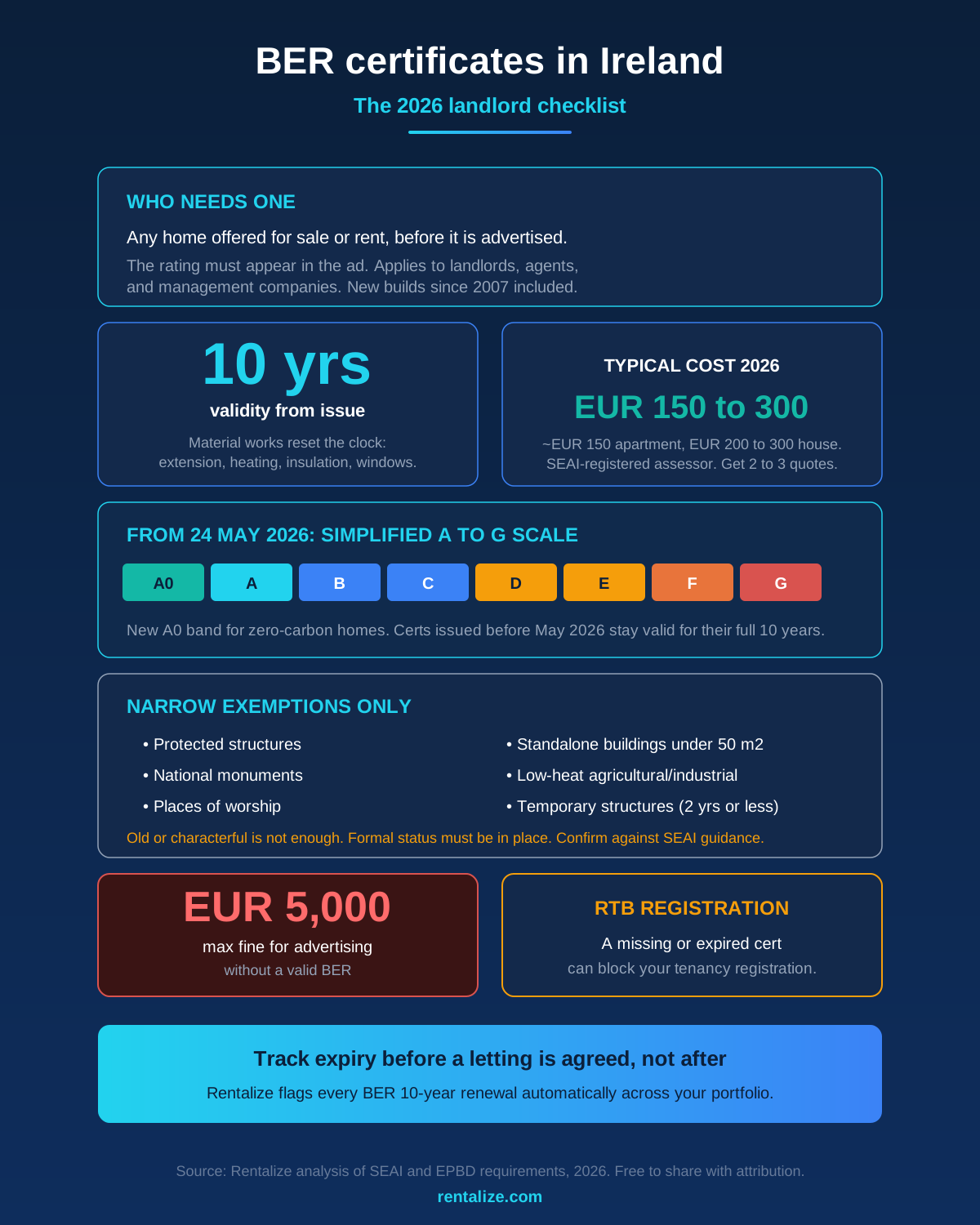
Almost every home offered for sale or rent in Ireland must hold a valid BER certificate before it goes to market, and the rating must appear in the advertisement. The obligation sits inside the wider RTB compliance workflow.
A BER certificate is valid for 10 years, unless material works (extension, new heating system, major insulation or window upgrade) reset the clock.
From 24 May 2026, new residential certificates use a simplified A to G scale, with a new A0 band for zero-carbon homes. Existing valid certs stay compliant for their full 10 years.
Exemptions are narrow: protected structures, national monuments, places of worship, certain agricultural buildings, and standalone buildings under 50 square metres.
Advertising without a valid BER can bring fines of up to EUR 5,000 and can block a tenancy registration with the RTB.
Picture this: your property is listed, a tenant is keen, and everything is ready to go. Then someone asks for the BER certificate and you realise it expired eight months ago. The letting stalls, the tenant keeps looking elsewhere, and you are scrambling to book an assessor on short notice.
This situation is more common than it should be across Irish rental portfolios, not because landlords are negligent, but because a 10-year validity window spread across multiple properties is genuinely easy to lose track of. Before you advertise, check the BER certificate requirement: most homes offered for rent or sale must hold a valid certificate, and the obligation applies from the moment the property goes to market.
The Building Energy Rating requirement in Ireland carries real legal weight, and 2026 has introduced a simplified A to G rating scale that makes this a good moment to get up to speed. Whether you manage a single rental or a portfolio of fifty units, knowing who needs a certificate, who is exempt, how long it lasts, and what it costs will save you from costly compliance gaps. Rentalize, the property management platform built for the Irish market, tracks BER expiry dates automatically as part of its compliance engine, but more on that later.
Which properties legally require a BER certificate in Ireland
Existing homes offered for sale or rent
Any residential property being advertised or offered for sale or rent in Ireland must satisfy the BER certificate requirement before it goes to market. The rating must also appear in any advertisement, whether online or in print. This obligation applies equally to private landlords, estate agents, and property management companies, so there is no route around it based on who is doing the marketing.
New builds, renovations, and off-plan sales
New dwellings where planning permission was applied for on or after 1 January 2007 require a Building Energy Rating before occupation. New non-domestic buildings follow a similar rule, with the relevant cut-off date set at 1 July 2008. Properties sold off-plan require a provisional BER certificate until the build is complete, at which point a full assessment on the finished dwelling must follow within 24 months of the provisional cert being issued.
The May 2026 rating scale change
From 24 May 2026, all new residential BER certificates use a streamlined A to G scale, replacing the previous 15-band system that ran from A1 and A2 down through sub-categories such as B1, B2, B3, and so on. The new scale introduces an A0 category at the top for zero-carbon homes with no reliance on fossil fuels. Existing valid certificates are not affected and remain legally compliant for their full 10-year lifespan, so there is no need to rush out for a reassessment if your cert was issued before May 2026 and nothing material has changed at the property.
Source: Rentalize analysis of SEAI and EPBD requirements, 2026. Free to share with attribution.
BER exemptions: which properties are not required to have one
Protected structures and national monuments
A building formally listed as a protected structure under planning and heritage law, or designated as a national monument, is exempt from the BER certificate requirement. The exemption exists because compliance could unacceptably alter the character or appearance of the building. It is worth noting, however, that a property that is simply old or of architectural interest does not automatically qualify; the formal protected status must be in place before the exemption applies.
Places of worship, agricultural buildings, and small standalone structures
Places of worship used principally for religious activities are exempt from the requirement. Non-residential agricultural and industrial buildings with an installed heating capacity of less than 10 W/m2 also fall outside the obligation. Standalone buildings with a total useful floor area under 50 square metres are exempt, as are temporary structures intended for use of two years or less.
How to confirm whether your exemption applies
Assumptions about exemptions can cause serious problems, particularly if you market a property and are later found to be non-compliant. If you believe your property qualifies for an exemption, cross-reference your situation against SEAI’s published guidance or take formal advice before advertising. For landlords managing a mixed portfolio, documenting each property’s exempt status in writing is good practice and provides protection in any future dispute or inspection. A useful summary of who is exempted from BERs is also available for reference.
BER certificate renewal: how long a certificate lasts
The 10-year rule explained
A BER certificate is valid for 10 years from the date of issue, provided the property has not undergone material changes that affect its energy performance. For most rental properties where nothing structural has changed, a single assessment covers a full decade. The certificate remains valid for advertising, letting, and RTB registration purposes throughout that period. For a concise summary on validity periods, see how long a BER certificate is valid for.
What counts as a material change requiring reassessment
Certain works reset the clock regardless of how recently the last assessment was done. An extension, a significant renovation, a change in heating system or fuel type, or a major upgrade to insulation or windows all count as material changes. If you carry out any of these works, you need a fresh assessment to accurately reflect the property’s updated energy performance, and you cannot rely on the previous certificate for legal compliance purposes.
Provisional BER certificates for new builds
A provisional BER issued for a home sold off-plan is valid for 24 months or until the property is completed, whichever comes first. A full assessment must then be carried out on the completed dwelling before it is occupied, sold, or let. Developers and landlords taking on newly built stock should build this follow-up assessment into their post-completion checklist from day one, rather than discovering the gap when a letting is already agreed.
Getting a BER assessment: what to expect and what it costs
Finding an SEAI-registered assessor and booking the visit
Only assessors registered with the Sustainable Energy Authority of Ireland are authorised to issue BER certificates in Ireland. You can find a registered assessor through the SEAI’s online directory, and it is worth gathering a few key details before you make contact: the property’s MPRN number from a recent electricity bill, the Eircode, the approximate construction year, and records of any relevant upgrades such as insulation, new windows, or a heating system change. Having these to hand speeds up the booking process and helps the assessor give you an accurate quote.
What the assessor checks on the day
A typical assessment takes between one and three hours, depending on the property’s size and complexity. The assessor inspects walls, roof, windows, doors, the heating system, hot water cylinder, ventilation, lighting, and any renewable energy installations. This data is entered into the DEAP calculation tool to generate the energy rating. At the end of the process you receive both the BER certificate and a BER advisory report that outlines recommended upgrades and their potential impact on the rating.
Typical BER assessment costs in Ireland in 2026
There is no fixed national fee, so prices vary by property size, location, and assessor. As a general benchmark, a standard apartment or typical home costs around EUR 150, while a larger house or duplex is more commonly priced at EUR 200 to EUR 300. Very large or complex properties can attract higher quotes. These figures align with assessor-quoted rates circulating in the Irish market and can serve as a reasonable budgeting reference, though it is always worth gathering two or three quotes before committing.
What happens if you don’t have a valid BER certificate
Legal consequences and advertising obligations
Advertising a property for sale or rent without a valid BER certificate, or failing to display the rating in the advertisement, is a breach of the European Communities (Energy Performance of Buildings) Regulations. Enforcement in Ireland sits with local authorities, and landlords found in breach can face fines of up to EUR 5,000 on summary conviction. Beyond the financial penalty, the absence of a valid certificate can complicate or delay a tenancy registration with the RTB, which has further downstream consequences for your legal standing as a landlord.
RTB registration and ongoing compliance
When registering a tenancy with the Residential Tenancies Board, a valid BER certificate is part of the required information a landlord must have on record, and the RTB’s registration system validates this as a required field. A missing or expired certificate creates a compliance gap that can surface during an RTB investigation or dispute, and without a valid cert the tenancy registration cannot be completed. The RTB provides guidance on how to register a tenancy if you need step-by-step support.
For landlords with larger portfolios, keeping every certificate current is not a paperwork formality. It forms part of the broader regulatory picture that the RTB and other bodies expect you to maintain at all times.
How to track BER expiry dates without missing a deadline
Why manual tracking fails landlords with growing portfolios
When you manage one or two properties, keeping a note of your BER renewal date in a diary is manageable. When your portfolio grows to ten, twenty, or fifty units, each with different assessment dates, heating upgrade histories, and new-build statuses, a spreadsheet becomes a compliance liability rather than a safeguard. Dates get missed, certificates expire quietly, and properties end up on the market without a valid BER, creating exactly the legal exposure the regulations are designed to prevent.
How Rentalize flags BER expiry dates automatically
Rentalize is built specifically for the Irish rental market, and its compliance engine tracks BER certificate expiry dates as a core feature. When a certificate is approaching its 10-year renewal date, the platform flags it in your dashboard and sends automated alerts so you can arrange a reassessment before the deadline arrives. The BER certificate requirement sits within the full RTB compliance workflow, meaning your tenancy records, certificate status, and registration obligations are all visible from a single login rather than scattered across email threads and spreadsheet tabs.
How Rentalize keeps your certificates current at scale
Manual tracking works until it doesn’t. The cost of a missed BER is not just the EUR 5,000 exposure, it is the stalled letting and the tenant who walks while you wait for an assessor. Rentalize’s compliance engine turns that reactive scramble into a scheduled task: every certificate carries its expiry, the dashboard surfaces what is due, and alerts land in time to book a reassessment before a letting is agreed.
For landlords and agents who want one place to manage tenancies, certificates, and registrations, Rentalize 360 keeps the whole compliance picture in a single auditable record. Property management companies running mixed portfolios use it to keep every client’s certificate status visible at a glance, rather than rebuilding a spreadsheet every quarter.
Do I legally need a BER certificate to rent out my property in Ireland?
Yes. With narrow exemptions, any residential property offered for rent in Ireland must hold a valid BER certificate before it is advertised, and the rating must be shown in the advertisement. The obligation applies to private landlords, agents, and management companies alike.
How long is a BER certificate valid for?
A BER certificate is valid for 10 years from the date of issue, provided no material changes have been made to the property. Works such as an extension, a new heating system, or a major insulation or window upgrade reset the clock and require a fresh assessment.
What changed with the BER scale in May 2026?
From 24 May 2026, new residential certificates use a simplified A to G scale instead of the old 15-band system, with a new A0 band for zero-carbon homes. Certificates issued before that date remain valid and compliant for their full 10-year term.
How much does a BER assessment cost in Ireland in 2026?
There is no fixed national fee. As a benchmark, a standard apartment or typical home costs around EUR 150, while a larger house or duplex is usually EUR 200 to EUR 300. Larger or more complex properties can cost more, so it is worth getting two or three quotes.
What happens if I advertise a property without a valid BER?
Advertising without a valid certificate, or failing to display the rating, breaches the Energy Performance of Buildings Regulations. Local authorities enforce this, and fines can reach EUR 5,000 on summary conviction. A missing or expired cert can also block a tenancy registration with the RTB.
Which properties are exempt from needing a BER?
Exemptions are narrow: protected structures, national monuments, places of worship, certain agricultural and industrial buildings with low heating capacity, standalone buildings under 50 square metres, and temporary structures intended for two years or less. Confirm any exemption against SEAI guidance before advertising.
Key takeaways Making Tax Digital for Income Tax has applied since April 2026 to qualifying income above 50,000 pounds. From April 2027 the threshold...


 Software Selection