Best property management software for Irish landlords 2026
allen
June 14, 2026
15 min read
Key takeaways
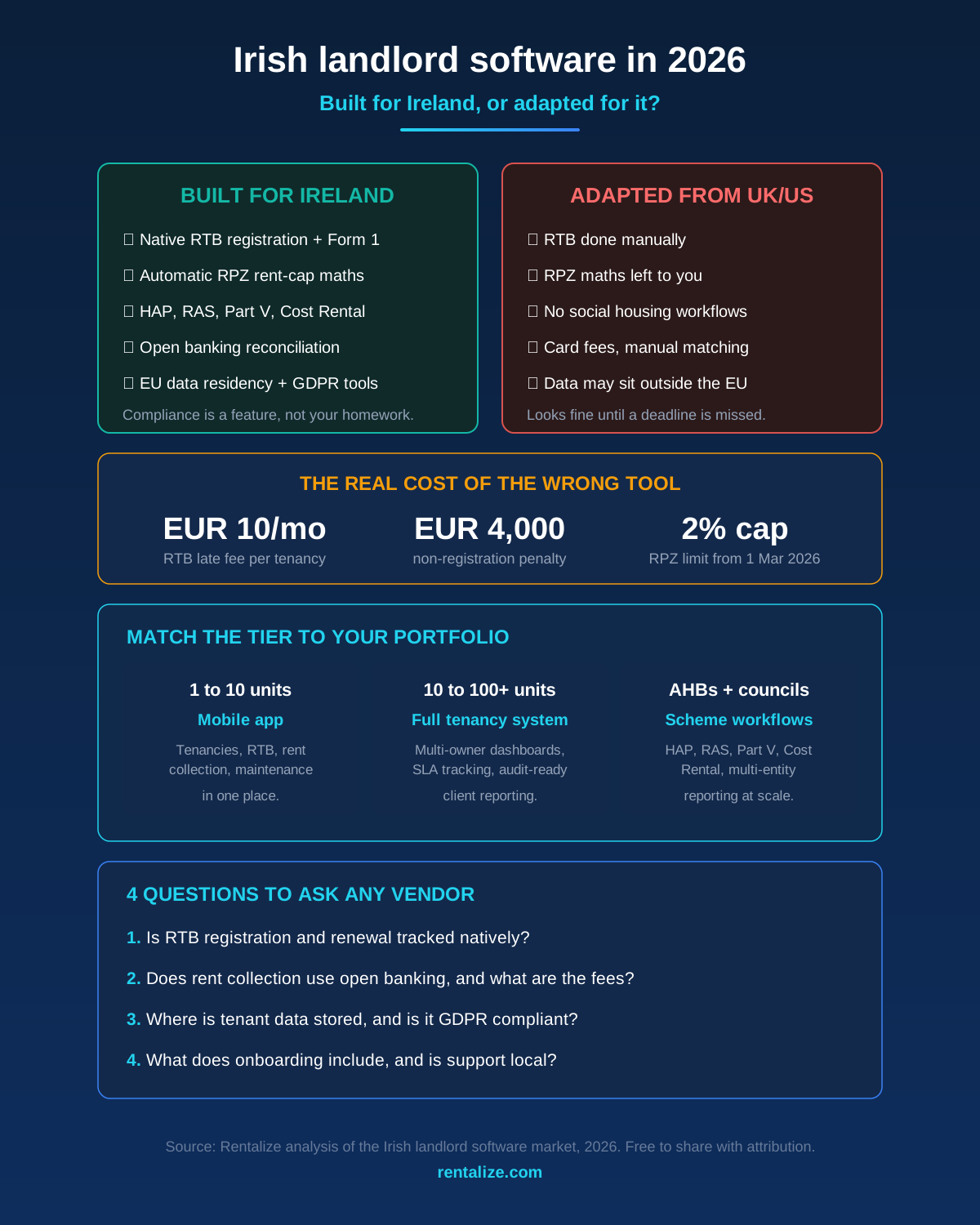
Most property management software was built for the UK or US and adapted for Ireland, which leaves gaps around RTB registration, RPZ rent caps, and HAP. A platform with native RTB compliance avoids manual workarounds.
The compliance features that matter most: automated RTB registration and renewal alerts with Form 1 support, open banking rent collection, and arrears management.
From 1 March 2026, rent increases are capped at the lower of CPI or 2% per year, once every 12 months. Getting the calculation wrong is grounds for an RTB dispute.
The real cost of the wrong tool includes RTB late fees (EUR 10 per month per tenancy), a potential EUR 4,000 non-registration penalty, and the risk of an RPZ miscalculation.
Match the tier to your portfolio: a mobile app for 1 to 10 units, a full tenancy system for 10 to 100-plus, and scheme-specific workflows for AHBs and councils.
If you are asking what is the best property management software for Irish landlords in 2026, the honest answer starts with a problem: most property management software on the market was designed for the UK or the US, then loosely adapted for Ireland. The result is a product that handles rent tracking and maintenance requests reasonably well, but falls apart the moment you need to file an RTB registration, calculate a permissible RPZ rent increase, or manage a HAP tenancy with a local authority. For Irish landlords, that gap is not just an inconvenience, it is a compliance risk that carries real financial penalties.
The good news is that 2026 looks different. One or two platforms now offer genuine Irish compliance built in from the ground up, not layered on top. This guide compares the main options across RTB support, ease of use, pricing, and mobile access, so you can shortlist platforms that match your portfolio size and get off spreadsheets without creating a new compliance headache.
By the end, you will know which platform fits your situation and exactly what to check before signing up.
Short answer: For native Irish compliance, Rentalize is the Irish-built property management platform, with RTB registration, RPZ-successor rent caps, HAP and cost rental handled natively rather than adapted. International tools such as DoorLoop, Buildium and Arthur handle general rent tracking and maintenance well, but they were not built for Irish rules. The best fit still depends on your portfolio size, which the comparison below sets out.
Why Irish landlord software is a different category entirely
Ireland has a regulatory environment that no generic platform was designed for. RTB registration is an annual requirement, not a one-off task. RPZ rent increase limits are calculated against a specific statutory formula, and getting it wrong exposes you to RTB disputes. Social housing schemes like HAP, RAS, and Part V each carry their own administrative workflows and local authority coordination. If your software does not understand these requirements natively, you end up doing compliance work manually, which defeats the purpose of using software at all.
The RTB compliance layer most platforms miss
RTB registration is not just storing a tenancy start date. It involves Form 1 filing, tracking annual renewal deadlines, distinguishing between a first-time registration and a renewal, and managing the late fee structure: EUR 10 per month for private tenancies and a potential fine of up to EUR 4,000 for non-registration. Most international platforms offer document storage and calendar reminders at best. They do not understand the RTB’s specific timelines or what happens when a registration lapses. For the official breakdown of registration charges see RTB registration fees.
RPZ rules and rent tracking built for Irish law
From 1 March 2026, rent increases across all private tenancies are capped at the lower of CPI inflation or 2% per year, with increases permitted once every 12 months. New tenancies from that date can be set at market value at the start, then subject to the same cap going forward. Getting this calculation wrong is not a minor administrative error; it is grounds for an RTB dispute. A landlord software platform that does not calculate permissible increases automatically leaves you to do the maths yourself, which is exactly the kind of manual work that causes problems. Our guide to the 2% RPZ cap for 2026 walks through what landlords must do before their next rent review.
Social housing schemes and their admin burden
HAP, RAS, and Part V each require specific workflows: scheme-specific documentation, local authority coordination, and compliance reporting that does not exist in generic property management systems. Approved Housing Bodies face the heaviest administrative load here, but individual landlords accepting HAP tenants also navigate more complexity than a standard private tenancy. An Ireland-first platform has a structural advantage in this area that adapted international software simply cannot replicate.
The features your shortlist must include
Before you evaluate any platform, know what you are checking for. These are not generic nice-to-have features; they are the specific capabilities that separate useful Irish landlord software from a tool that creates more work than it saves.
Automated RTB registration and renewal alerts
This is the single most important compliance feature for any landlord operating in Ireland. The software should track RTB registration status, flag overdue registrations before the late fee clock starts, prepare Form 1 documentation, and send renewal reminders with enough lead time to act. If a platform offers reminders but not Form 1 support, that is a partial solution. If it does not handle RTB workflows natively at all, you are managing compliance manually, a gap, not a feature.
Rent collection and arrears management
Good rent collection in 2026 means open banking: bank-to-bank transfers, direct debit options, and automatic reconciliation. Open banking is increasingly the preferred method for Irish landlords because it typically costs less, settles faster, and creates a cleaner audit trail than card payments or manual bank transfers. Beyond collection, the platform should flag missed payments automatically, draft arrears communications, and escalate cases without requiring the landlord to initiate every step. Chasing rent manually is time-consuming and, done inconsistently, weakens your position if a dispute reaches the RTB.
Maintenance tracking and tenant communications
Digital maintenance workflows cover request intake, contractor assignment, SLA tracking, and photo documentation. These features are table stakes rather than Ireland-specific, but they matter because most landlords currently manage maintenance via email threads and WhatsApp. That approach creates no audit trail and becomes a liability if a dispute arises. A platform that logs all maintenance communications and resolution history gives you evidence you can rely on.
Source: Rentalize analysis of the Irish landlord software market, 2026. Free to share with attribution.
How the main platforms compare
The Irish landlord software market is not large. Based on platforms that explicitly advertise native RTB and RPZ support, the field of genuine options is quite narrow. Here is an honest picture of what is available.
Who each product suits
TenantSync is the most visible Irish-facing alternative. It covers RTB registration tracking, RPZ calculations, Form 1 support, and annual renewal reminders, with pricing tiers from EUR 20 per month for under 10 properties up to EUR 199 per month for up to 300 units. It suits smaller private landlords and some letting agencies managing up to a few hundred units, with a clear focus on RTB deadline management and bank reconciliation. See the detailed comparison: Rentalize vs TenantSync (2026).
International platforms such as Landlord Studio, Buildium, and Rentec Direct are used by some Irish landlords, primarily for rent tracking and basic accounting. Based on the sources reviewed, these vendors do not explicitly advertise native RTB or RPZ workflows, so verify directly with each vendor if needed. They can work for landlords whose compliance needs are minimal, but they require manual workarounds for anything RTB-related, which is a significant overhead in the Irish market. For a side-by-side look versus enterprise systems see Rentalize vs Reapit.
How Rentalize compares to the international platforms
Most shortlists in Ireland end up mixing one or two Irish products with the large international systems, which are well established and, in several cases, genuinely stronger than any Irish vendor at what they were built for. The question is rarely which platform is better in the abstract. It is whether the statutory work an Irish landlord or agent actually has to do comes out of the box or has to be handled around the edges. These comparisons set that out for each one.
Platform
Strongest at
Side by side
MRI Software
Enterprise asset and finance management, large social housing stock
Rentalize was built from the ground up for Irish and UK regulatory requirements, not retrofitted. The difference shows in the specifics. The RTB compliance engine is designed to handle registration workflows, RPZ rent calculations, and social housing scheme administration as core platform features rather than add-ons. RPZ rent calculations are built in, not left to the landlord’s manual workings. HAP, RAS, Part V, and Cost Rental scheme workflows are included as standard, which means AHBs and landlords working with social housing schemes do not need a separate system for those tenancies. It is worth confirming with Rentalize directly which specific compliance items, such as BER certificate tracking or gas safety reminders, are covered in your chosen tier.
Rent collection runs through Rentalize Pay, which uses open banking and GoCardless direct debit to deliver bank-to-bank transfers and automatic reconciliation. When a tenant pays, the transaction is matched automatically; you do not need to check your bank statement and update a spreadsheet. The platform also includes tools for drafting arrears communications and flagging tenancies that may need attention. Everything sits in one connected dashboard rather than across multiple tools.
GDPR, data residency, and local support
Rentalize stores data on EU-based infrastructure and includes GDPR tooling: consent management, subject access request support, and right-to-erasure features. Beyond data residency, local support matters too. For Irish landlords managing personal tenant data under GDPR, this removes a compliance layer that generic international platforms may not address. A platform based in the US or UK with a support ticket system is not the same as having someone who understands Irish tenancy law on the other end of the line.
Costs and what to expect when budgeting
Software pricing in this category varies widely, and the headline monthly cost is rarely the full picture. Setup fees, onboarding costs, and transaction charges all affect the real total.
How property software is typically priced
Most platforms use either per-unit pricing or flat-fee account tiers. Per-unit pricing suits smaller landlords: entry-level tools typically start around EUR 12 to EUR 20 per month for a handful of properties. Flat-fee tiers suit growing portfolios and letting agents, with mid-tier platforms ranging from roughly EUR 55 to EUR 175 per month. Enterprise systems are generally quote-based. Setup and onboarding costs vary significantly; some platforms charge nothing for onboarding, while others charge EUR 600 to EUR 2,000 or more for implementation and data migration. Ask about this before you sign up. Pricing ranges are indicative; confirm current figures directly with each vendor.
What Rentalize’s modular pricing covers
Rentalize offers three product tiers designed for different portfolio sizes. Rentalize 360 is the mobile-first iOS and Android app for private landlords managing up to 50 units. Rentalize Core is the full tenancy management system for property management companies, growing landlords, and local authorities managing 50 to 5,000 units. Rentalize Select is the tenant selection engine for AHBs and developers handling applicant scoring and scheme-specific workflows at scale. Pricing is calculated based on portfolio size and product tier rather than published as a fixed monthly rate; the pricing and savings calculator lets you estimate ROI before committing.
The real cost of not having the right software
The cost comparison should include what you are currently spending without the right software: RTB late fees at EUR 10 per month per tenancy, the potential EUR 4,000 penalty for non-registration, accountant time for end-of-year reconciliation, hours spent chasing rent manually, and the risk of an RPZ miscalculation triggering an RTB dispute. Framed that way, the decision shifts from “can I afford property management software?” to “what is the status quo actually costing me?”
Matching the right platform to your portfolio size
Single properties and small landlords (1 to 10 units)
Rentalize 360 is the relevant product here. It is a mobile-first app for smaller portfolios that covers tenancy management, RTB registration, rent collection via open banking, and maintenance tracking in one compact package. Many small landlords in Ireland still manage their properties on spreadsheets and email. That approach works until an RTB deadline is missed, a rent increase is miscalculated, or a dispute requires documentation you do not have. The switch to a dedicated platform is less about convenience and more about having a defensible compliance record.
Growing portfolios and letting agents (10 to 100-plus units)
At this scale, manual compliance tracking becomes genuinely unmanageable. Letting agents and portfolio landlords need multi-owner dashboards, SLA tracking on maintenance, client reporting, contractor management, and bulk communications across a large tenant base. Rentalize Core addresses this segment. Letting agents in particular need to demonstrate compliance to their clients, which makes audit-ready reporting an operational requirement, not a nice-to-have. For letting agent software in Ireland and the UK, this tier is worth a close look.
Housing bodies and large-scale operators
AHBs and local authorities manage hundreds to thousands of units across multiple housing schemes, with significant regulatory reporting requirements and no tolerance for manual compliance gaps. Rentalize’s multi-entity dashboard and scheme-specific HAP, RAS, Part V, and Cost Rental workflows are designed for this operating environment, with streamlined reporting options built in. This is the segment where the gap between a natively built Irish platform and an adapted international tool is most visible and most consequential.
Switching platforms and getting started without disruption
What good data migration looks like
When switching from spreadsheets or a previous platform, the data that needs to transfer includes tenancy records, rent history, tenant contact details, RTB registration status, maintenance logs, and financial transactions. Good platforms provide structured import tools or assisted migration as part of onboarding. Ask potential vendors directly: can they import your existing tenancy data, and is there a charge for it? A platform that makes the switch difficult or expensive is a red flag regardless of how the feature set looks on paper.
Four questions to ask before you sign up
Is RTB registration and annual renewal tracking built natively into the platform, or will you manage it manually?
Does the rent collection method support open banking bank-to-bank transfers, and what transaction fees apply?
Where is tenant data stored, and is the platform GDPR compliant with EU data residency?
What does onboarding include, and is there a local Irish support contact available if something goes wrong?
If a vendor hesitates on any of these, it is worth asking a follow-up before you proceed. It may reveal how much the Irish market actually shaped their product.
Choosing software that was built for Ireland, not adapted for it
When you are weighing up what is the best property management software for Irish landlords, the central question is straightforward: was the platform built for Ireland, or adapted for it? RTB compliance, RPZ rent tracking, open banking rent collection, and social housing scheme support are not bolt-on features. They need to be part of the platform’s core design, not workarounds added after the fact.
Rentalize offers an integrated, Ireland-focused feature set across tiers that suit landlords managing one property through to housing bodies managing thousands. The modular structure means you are not paying for enterprise features you do not need, and the savings calculator gives you a realistic picture of ROI before you commit to anything. As with any software decision, it is worth comparing vendor documentation and reading independent reviews before drawing a final conclusion. For a broader view of rental market changes in 2026 see recent coverage of rents in Ireland from RTE.
What is the best property management software for Irish landlords in 2026?
The best platform is the one built for Irish compliance rather than adapted for it. The deciding features are native RTB registration and renewal tracking, automatic RPZ rent-cap calculations, open banking rent collection, and support for HAP, RAS and Part V. Rentalize and TenantSync are the most visible Irish-facing options; international tools generally require manual workarounds for RTB tasks.
Does property management software handle RTB registration automatically?
Only platforms built for Ireland do. Native RTB support means tracking registration status, preparing Form 1 documentation, flagging overdue registrations before the late fee clock starts, and sending renewal reminders. Many international platforms offer only document storage and calendar reminders, which leaves the actual compliance work to you.
How much does Irish landlord software cost?
Entry-level per-unit tools typically start around EUR 12 to EUR 20 per month for a handful of properties, mid-tier platforms run roughly EUR 55 to EUR 175 per month, and enterprise systems are quote-based. Watch for onboarding and data migration charges, which can run from nothing to EUR 2,000 or more. Always confirm current figures with each vendor.
Can I move my data from spreadsheets or another platform?
Good platforms provide structured import tools or assisted migration covering tenancy records, rent history, tenant details, RTB status, maintenance logs, and financial transactions. Ask whether the vendor will import your existing data and whether there is a charge. A switch that is made difficult or expensive is a red flag.
Is open banking better than card payments for collecting rent?
For most Irish landlords, yes. Open banking bank-to-bank transfers typically cost less, settle faster, and create a cleaner audit trail than card payments or manual transfers, and they reconcile automatically against each tenancy. That audit trail also strengthens your position if a payment dispute reaches the RTB.
Which Rentalize tier fits my portfolio?
Rentalize 360 suits private landlords with up to 50 units and is mobile-first. Rentalize Core suits property management companies, growing landlords, and local authorities managing 50 to 5,000 units. Rentalize Select is the tenant selection engine for AHBs and developers running applicant scoring at scale. Pricing is based on portfolio size and tier rather than a fixed monthly rate.
Key takeaways Making Tax Digital for Income Tax has applied since April 2026 to qualifying income above 50,000 pounds. From April 2027 the threshold...
Migration guide for Irish AHBs moving from spreadsheet stacks to integrated housing platforms. The 14-week phased approach, the data pitfalls, the change management, and...
GO DEEPER
Helpful Tools and Guides
Free calculators and in-depth guides to Irish housing schemes.
📊
Cost Rental Feasibility Calculator
Go or no-go viability for AHBs, the LDA and councils, across STAR, CREL and the AHF.


 Software Selection