Spreadsheets vs property management software for Irish landlords
allen
June 14, 2026
10 min read
Key takeaways
A spreadsheet works for one or two tenancies. It starts costing you money the moment an RTB deadline, an RPZ calculation, or a deposit dispute needs a record the sheet does not hold. The honest comparison is in our guide to the best property management software for Irish landlords.
Spreadsheets have no audit trail, no reminders, and no link to your bank. Every rent reconciliation and every compliance check is manual, which is where errors creep in.
Software earns its keep the first time it catches an RTB renewal, calculates a permissible rent increase, or reconciles a payment you would otherwise have missed.
For a small landlord, the question is not “can I afford software?” but “what is the spreadsheet already costing me in late fees, accountant hours, and dispute risk?”
The switch is cheaper and faster than most landlords expect, especially with open banking rent collection that reconciles automatically.
Most Irish landlords start with a spreadsheet, and for a single tenancy that is a perfectly reasonable choice. A few columns for rent due, rent paid, and a running balance will carry you a long way. The trouble is that a spreadsheet does not scale, and more importantly, it does not know anything about Irish tenancy law. It will not tell you an RTB registration is due, it will not stop you setting a rent increase above the cap, and it will not give you a defensible record when a tenant disputes a deposit.
So the real question is not whether spreadsheets work. It is whether they are quietly costing you more than software would. Late fees, hours spent reconciling rent by hand, an accountant untangling your figures at year end, and the risk of a single miscalculation triggering an RTB dispute all add up, and none of them show on the spreadsheet itself.
This guide puts the two approaches side by side for the Irish market: where a spreadsheet genuinely holds up, where it quietly fails, and how to tell when you have crossed the line from “fine for now” to “this is a liability.” By the end you will know whether property management software is worth it for your portfolio, and what to look for if it is.
It is worth being fair to the spreadsheet, because it does some things well. For a landlord with one or two tenancies, a spreadsheet is free, flexible, and entirely under your control. You can see every figure at once, change anything instantly, and there is no learning curve. If your rent arrives reliably, your tenants are long-term, and your compliance needs are minimal, a well-kept sheet can genuinely hold the line for a while.
The key phrase is “for a while.” A spreadsheet works right up until the moment it does not, and the failure is usually invisible until it costs you. The landlord who misses an RTB renewal was not careless; they were relying on a tool that has no concept of a deadline.
Where spreadsheets quietly fail Irish landlords
The gaps are specific, and every one of them maps to a real cost in the Irish market.
No reminders, no deadlines
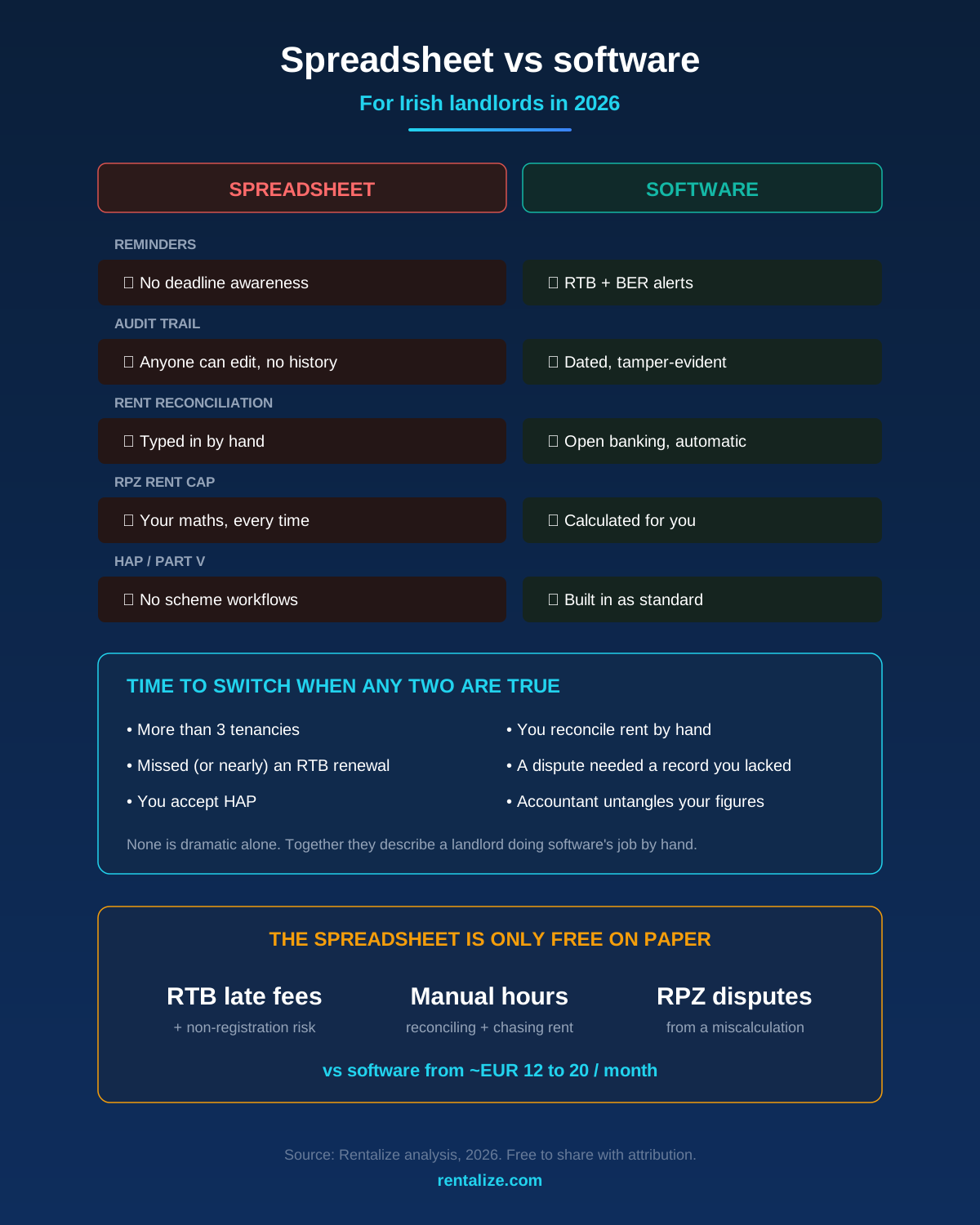
A spreadsheet cannot tell you that an RTB registration is due, that a rent review window has opened, or that a BER certificate is about to expire. It holds dates; it does not act on them. In a market where missing an RTB registration can mean late fees and a potential penalty, a tool that stays silent is a tool that lets problems mature.
No audit trail
When a tenant disputes a deposit deduction or claims a payment was made, you need a dated, tamper-evident record. A spreadsheet that anyone can edit, with no history of who changed what and when, is weak evidence at an RTB hearing. The same applies to maintenance: an email thread and a row in a sheet are not the documented resolution history that protects you in a dispute.
No link to your bank
Every payment in a spreadsheet is typed in by hand from a bank statement. That manual reconciliation is slow, and it is exactly where errors live: a missed payment, a transposed figure, a partial payment recorded as full. Open banking rent collection removes that step entirely by matching each payment to the right tenancy automatically.
No compliance logic
This is the big one. A spreadsheet does not know the RPZ rent cap, does not calculate a permissible increase, and does not understand HAP or Part V workflows. Every compliance calculation is yours to get right, by hand, every time. Software that has this logic built in turns a manual, error-prone task into a check.
Source: Rentalize analysis, 2026. Free to share with attribution.
Spreadsheet vs software, side by side
Stripped to the essentials, the difference is between a tool that stores information and a tool that acts on it. A spreadsheet is a filing cabinet; software is a filing cabinet that also reminds you, calculates for you, and reconciles your bank. For a landlord whose obligations are largely manual today, that shift is the whole point.
The honest caveat is that software is not free, and a cheap tool that does not understand Ireland can be worse than a good spreadsheet. The comparison that matters is not spreadsheet versus any software; it is spreadsheet versus software built for RTB compliance. A generic international tool that stores documents and sends calendar reminders sits awkwardly between the two, costing money without removing the manual compliance work.
Is property management software worth it for small landlords?
For a landlord with a single, stable tenancy, software may be a convenience rather than a necessity. The calculation changes the moment any of the following is true: you have more than two or three tenancies, you accept HAP, you face an RTB renewal you could forget, or you have ever spent an evening reconciling rent against a bank statement. At that point the software is not an expense, it is insurance against costs you are already exposed to.
Frame it as a comparison of totals, not of monthly fees. Against the cost of a subscription, set the RTB late fees you risk, the accountant time a clean ledger saves, the hours you spend chasing rent manually, and the financial exposure of a single RPZ miscalculation. For many small landlords, the status quo is already the more expensive option; it just bills you in irregular, easy-to-ignore instalments. Our roundup of the best landlord software for 1 to 10 properties breaks down what that looks like at the smaller end.
The tipping point: when to leave the spreadsheet behind
There is a fairly reliable set of signals that you have crossed the line. Any two of these together is a strong case to switch:
You manage more than three tenancies, or expect to soon.
You have missed, or nearly missed, an RTB registration or renewal.
You accept HAP or manage any social housing tenancy.
You reconcile rent against your bank statement by hand each month.
A tenant dispute has left you searching emails for a record you could not produce.
Your accountant charges you to untangle your figures at year end.
None of these is dramatic on its own. Together they describe a landlord who is doing, manually and at some risk, the exact work software is built to remove.
Automating rent tracking in Ireland
If there is one feature that justifies the move on its own, it is automated rent tracking. In a spreadsheet, every payment is a manual entry copied from your bank, and every missed payment is something you have to notice. With open banking, payments reconcile against the correct tenancy automatically, partial and late payments are flagged the moment they happen, and the arrears conversation can start in week one rather than month three.
That early flag matters beyond convenience. A landlord who spots a shortfall immediately has more options and a stronger position than one who discovers it a quarter later. It also feeds directly into the record you would rely on if arrears ever reach the RTB, which is the subject of our guide to chasing rent arrears. The audit trail that automated tracking produces is the same evidence that wins a hearing.
How Rentalize compares to a spreadsheet
Rentalize was built to do the things a spreadsheet structurally cannot. RTB registration and renewal tracking surface the next deadline before it costs you. RPZ rent calculations are built in, so a permissible increase is a check rather than a manual sum. Rent collection runs through open banking and direct debit, reconciling each payment automatically against the right tenancy. Every action leaves a dated record, which is the audit trail a spreadsheet never produces.
For a small landlord, Rentalize 360 puts all of that in a mobile app you can run from your phone, with import that lets you move off the spreadsheet in an afternoon. Growing portfolios and letting agents step up to Rentalize Core for multi-owner dashboards and audit-ready reporting. Either way, the spreadsheet stops being the system of record and becomes, at most, a backup.
If you would like to see what moving off the spreadsheet would save you, the savings calculator gives you a realistic figure before you commit, and you can book a 20-minute walkthrough from there.
Frequently asked questions
Is property management software worth it for small landlords in Ireland?
If you have a single stable tenancy, a spreadsheet may be enough. Software becomes worth it once you manage more than two or three tenancies, accept HAP, face RTB renewals you could forget, or reconcile rent by hand. At that point it offsets late-fee risk, accountant time, and dispute exposure that the spreadsheet quietly leaves you carrying.
What can a spreadsheet not do that software can?
A spreadsheet cannot remind you of an RTB deadline, calculate a permissible RPZ rent increase, reconcile payments against your bank, or produce a tamper-evident audit trail. It stores information; it does not act on it or apply Irish compliance logic. Those gaps are where manual errors and missed deadlines occur.
How do I automate rent tracking in Ireland?
Use a platform with open banking rent collection. Instead of typing each payment in from a bank statement, payments reconcile automatically against the correct tenancy, and partial or late payments are flagged immediately. That removes the slowest, most error-prone part of managing rent in a spreadsheet.
What counts as RTB-compliant software?
Software that handles RTB registration and annual renewal tracking natively, prepares Form 1 documentation, and calculates permissible RPZ rent increases, rather than just storing documents and sending calendar reminders. The test is whether the compliance work is done for you or merely filed for you to do.
Is it hard to move from a spreadsheet to software?
Usually not. Most platforms let you import tenancy records, rent history, and contacts directly, so a small landlord can move off a spreadsheet in an afternoon. Keep your spreadsheet as a backup until the first rent cycle has reconciled on the new system.
How much does landlord software cost compared to a free spreadsheet?
Entry-level tools typically start around EUR 12 to EUR 20 per month for a handful of properties. The spreadsheet is free in subscription terms only; its real cost shows up as RTB late fees, manual reconciliation hours, accountant time, and dispute risk, which together often exceed the price of software.
Key takeaways Making Tax Digital for Income Tax has applied since April 2026 to qualifying income above 50,000 pounds. From April 2027 the threshold...
Migration guide for Irish AHBs moving from spreadsheet stacks to integrated housing platforms. The 14-week phased approach, the data pitfalls, the change management, and...
GO DEEPER
Helpful Tools and Guides
Free calculators and in-depth guides to Irish housing schemes.
📊
Cost Rental Feasibility Calculator
Go or no-go viability for AHBs, the LDA and councils, across STAR, CREL and the AHF.


 Software Selection